Internal Rate of Return
What is the Internal Rate of Return?
The Internal Rate of Return (IRR) is a discount rate metric used to estimate profitability by making the Net Present Value (NPV) of a project or investment equal to zero. Essentially, it calculates the expected annual rate of return of a project or investment.
IRR Formula
The formula is rather complex and tedious, which is why most people use Excel or a Financial Calculator to figure out the IRR. Regardless, here is the formula:
NPV = Net Present Value, N = Total Number of Time Periods, n = Time Period, CF0 = Initial Investment, CF1+ = Cash Flows, IRR = Internal Rate of Return
Purpose of IRR
The main purpose of the IRR is to determine if a project or investment is at least in the break even point to be worth considering. However, most scenarios use the IRR of existing projects and new projects to determine if it’s better to start a completely new operation, or to expand an existing one. Even if both projects generate value, there will be a better choice for a company, which is typically denoted from the IRR.
The Limitations
One of the biggest problems with the IRR is that it doesn’t account for changing discount rates, making it less useful in longer term projects. Outside of capital planning and budgeting, the IRR can be misleading or misinterpreted. Although that may not be applicable in every scenario, the IRR is an annual return based on estimated cash inflows. Using the IRR or the NPV by itself to determine an outcome is a flawed practice. Most analysts compare and discuss them with Weighted Average Cost of Capital (WACC) and the Required Rate of Return (RRR).
Outcomes of IRR
When you calculate the IRR, it can result in a negative, zero, or positive.
Negative: The negative represents that the present value of cash outflows exceeds the present value of cash inflows; meaning the project or investment is at a loss.
Zero: When the IRR is zero, it’s what’s called the break even point; the total cash outflows and cash inflows are equal, which is neither a loss nor gain.
Positive: The best scenario is positive, which indicates the cash outflows does not exceed the cash inflows; meaning the project or investment is a gain.
There are even times when the IRR is a positive and the NPV is a negative. This situation occurs when the project’s cost of capital (WACC) exceeds the IRR. In these scenarios, the project/investment is usually rejected.
Weighted Average Cost of Capital (WACC)
The Weighted Average Cost of Capital (WACC) is a metric that averages the after-tax cost of all capital sources to determine its financing costs. In layman terms, it’s the average rate a company pays to finance its business from both debt and equity sources.
As I mentioned before, the IRR is best used when compared with other metrics. Most companies will want the IRR to exceed the WACC. This makes sense logically since you’d want your cash inflows from the project to be able to finance business operations over the project years.
Required Rate of Return (RRR)
The Required Rate of Return, also known as the hurdle rate, is the acceptable minimum return the investment must make. The general rule is that if the return of an investment is less than the required return, you reject the investment. The RRR will be greater than the WACC.
Similar to WACC, if the IRR exceeds the RRR, the project or investment will be worthwhile and profitable. Like we discussed earlier, it’s not the sole reason for a project or investment to be pursued, as they will compare it with other projects; existing or new.
Example
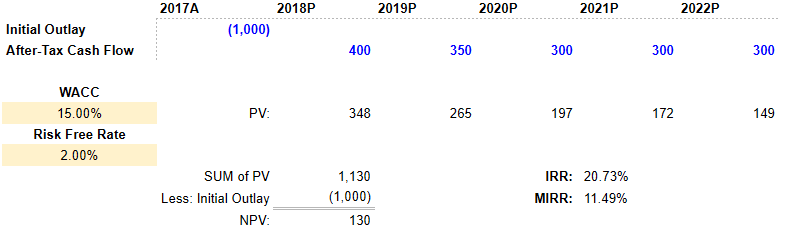
Company A wants to start a new marketing campaign, but they must consider which project is better to pursue. These are the project projection results:
Project B:
Project A:
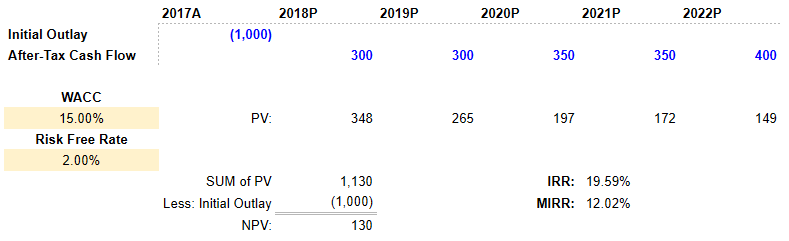
With Project B, we have an Initial Cost of $1,000; with cash inflows of $300, $300, $350, $350, and $400 in those predicted years. After calculating the PV, we find out that the NPV is also $130, but with an IRR of 19.59%.
With Project A, we have an Initial Cost of $1,000; with cash inflows of $400, $350, $300, $300, and $300 in those predicted years. After calculating the PV, we find out that the NPV is $130, with an IRR of 20.73%.
The obvious option between the two is Project A, as the IRR and WACC difference is greater than what Project B offers, despite having the same NPV result. We’ll notice that the only significant change is how the cash inflows in Project A has a stronger start and slowly goes down, while Project B is the opposite.
The Bottom Line
Although the IRR is a good metric in determining if a project is worth pursuing, it’s best used as a metric to compare with other useful metrics. Typically comparing it with the WACC or RRR will provide more intel of the investment or project. There isn’t a definitive “good internal rate of return” as it will differ in each scenario, but a positive IRR is usually good in short-term project forecasting. It’s especially good when compared with other project’s or investment’s IRR. There are a good amount of limitations that need to be considered, so don’t just believe that a positive IRR is always a good thing and that it’s the best option.
-
(February 1, 2022). IRR Formula: What it is and how to use it. Bungalow. https://bungalow.com/articles/irr-formula-what-it-is-and-how-to-use-it
(Retrieved July 2, 2026). What is weighted average cost of capital (wacc)? ECapital. https://ecapital.com/financial-term/weighted-average-cost-of-capital-wacc/
(Retrieved July 1, 2026). What is Negative IRR?. Superfast CPA. https://www.superfastcpa.com/what-is-negative-irr/#:~:text=A%20negative%20IRR%20occurs%20when,projected%20loss%20on%20the%20investment
Bell, M. (Retrieved July 1, 2026). Understanding Internal Rate of Return (IRR) for the PMP Exam. Project Management Academy. https://projectmanagementacademy.net/resources/blog/internal-rate-of-return/#:~:text=IRR%20represents%20the%20discount%20rate,where%20cash%20inflows%20match%20outflows
CFI Team. (March 26, 2019). Required Rate of Return. Corporate Finance Institute. https://corporatefinanceinstitute.com/resources/career-map/sell-side/capital-markets/required-rate-of-return/
Fernando, J. (February 13, 2026). Internal Rate of Return (IRR): Formula and Examples. Investopedia. https://www.investopedia.com/terms/i/irr.asp
Singhal, B. (May 15, 2024). Net Present Value vs Internal Rate of Return. Financial Edge. https://www.fe.training/free-resources/valuation/net-present-value-vs-internal-rate-of-return/
Vipond, T. (February 27, 2020). Internal Rate of Return (IRR). Corporate Finance Institute. https://corporatefinanceinstitute.com/resources/valuation/internal-rate-return-irr/
