Buy Now, Pay Later and Introspective
What is BNPL?
The abbreviated term stands for Buy Now, Pay Later. It is a short-term loan that allows buyers to purchase products in installments in a set time that bears no interest. The objective is to make more expensive products more “affordable” by slowly paying them off, rather than paying it in full value immediately.
To be more precise, BNPL is a credit product and is typically offered at the point-of-sale. Point-of-Sale means the time and place where the customer would pay for the product. BNPL are defined into two categories: Short-Term and Long-Term
Short-Term: BNPL products with maturities of up to 30 days or 4 weeks. They are often referred to as “Pay In 4” and make subsequent payments in two-week intervals.
Long-Term: BNPL products with maturities longer than 30 days. The buyers make monthly payments, typically 30 days after the purchase.
How It Works
Merchants (Sellers) typically form a partnership with FinTech Companies (Lenders) to reach an agreement on other potential payment plans. This allows the buyers to use the partner’s alternative payment plans to purchase goods, assuming it is approved by the merchants. Even if the option appears during point-of-sale, merchants may not agree to BNPL payments.
Another important process is that the lenders may conduct a soft credit check/inquiry before approving the loan. It doesn’t necessarily affect your credit score, but if the lender notices the buyer doesn’t yield to repayments or has late/missing payments, it can be reported to credit bureaus, thereby hurting the buyer’s credit history.
With this agreement, whenever a buyer goes through with a BNPL payment plan, the lender will pay the full amount to the merchant. In return, the merchant has to pay the lender a fee for each transaction completed through this short-term credit loan. This fee is typically three to six percent of the purchase price.
Potential Risks
Like almost all loans, there will be risks that the lenders will face when providing BNPL loans. These risks include: Limited Regulation and Defaulting Risk.
Limited Regulation: Due to the nature of BNPL plans being zero-interest and zero fees, they often bypass many credit laws. From a buyer perspective, it means they don’t get strong protection and don’t have many dispute resolution options.
Defaulting Risk: Due to the popularity of these loans, especially amongst lower income and higher debt individuals, the lenders have a higher chance of the buyers missing or even failing to make repayments.
The Success
Now that we understand how it benefits the buyers and lenders, we still need to understand how it benefits the merchants. However, there is one key detail that needs to be addressed. Typically, the fees merchants pay are often higher than the fees charged by credit card companies. If this is the case, why do the merchants make BNPL agreements with the lenders? Zhu Wang raises a potential correlation as to why they do so,
“... the subsidy allows merchants to make sales to customers who would not otherwise make a purchase, it increases merchant profit, consumer surplus and social welfare” - Zhu Wang January 3, 2025.
The correlation seems pretty strong, as merchants are benefitting enough to pay off the fees they owe to the lenders. To prove this, the demographic of the usage of BNPL payment plans found that the target audience were often younger, individuals without a college degree, and having lower credit scores. This relationship decreases as income increases (Wang 12). This is even supported by Joanna Stavins’ article, where she points out that in 2023, BNPL usage was roughly 9%, but has risen to roughly 40% in the following two years.
The Federal Reserve has an article that even discloses the top lenders of these loan issuances from 2019 to 2025.
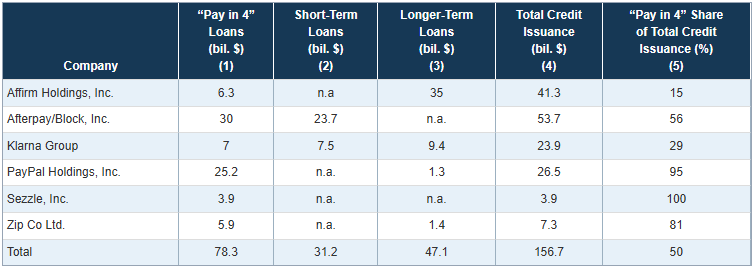
These numbers are in billions, they are clearly extremely profitable to lenders, merchants, and provide affordability to buyers. It’s no surprise that they’re successful.
Other Risks
Despite its popularity, why aren’t most businesses adopting BNPL agreements and why aren’t other FinTech companies doing this as well? One reason could be that these agreements pose a major problem on merchant costs.
Wang proposes that one of the goals merchants hope to achieve is tailored pricing based on price sensitivity. What this means is that by charging regular retail prices to customers who don’t use BNPL plans and a subsidy to customers who do use BNPL plans, they can maximize profits and sales. However, by offering these services excessively, customers will only want to pay this way, making the other cheaper payment options obsolete. This damage could be permanent, as customers accept this new payment system, merchants are unable to deny these loans, forcing the fees to stay the same or rise.
The other reason why other FinTech companies or banks don’t do the same is because they don’t need to. When we look at the top lenders, the competition is already intense and it is hard to make a name for smaller companies or banks. They also don’t need to spend resources to go into these markets, as traditional loans are extremely lucrative to banks.
Conclusion
The goal is to have BNPL payment plans to be more regulated so that it can provide consumer protection and prevent future complications amongst merchants. Luckily, not all merchants need or want to maximize profits, nor do all banks and companies need to be issuers of BNPL. They’re great short-term loans that realistically benefit everyone. Although as a consumer, we should still be careful about expensive purchases, even if BNPL makes it more “affordable”.
-
(January 13, 2026). Buy Now, Pay Later: What Merchants Need to Know. Chargeback Gurus. https://www.chargebackgurus.com/blog/buy-now-pay-later
Acree, R N., Barnes K., Bruce A., Hannon M. S. (June 5, 2026). “Buy Now, Pay Later” Beyond “Pay in 4”, A Comprehensive Product Overview. Board of Governors of the Federal Reserve System
Stavins, J. (May 23, 2024). Buy Now, Pay Later: Who Uses It and Why. Federal Reserve Bank of Boston. https://www.bostonfed.org/publications/current-policy-perspectives/2024/buy-now-pay-later-who-uses-it-why.aspx
Udavant, S. (October 8, 2025). Buy Now, Pay Later (BNPL): What It Is, How It Works, Pros and Cons. Investopedia. https://www.investopedia.com/buy-now-pay-later-5182291
Wang, Z. (January 3, 2025). Buy Now, Pay Later: Market Impact and Policy Considerations. Federal Reserve Bank of Richmond. https://www.richmondfed.org/publications/research/economic_brief/2025/eb_25-03
